Treatment centre
Peak Performance
Your Brain Is Your True Boss – Train It Like an Athlete
Top positions in business and sport are held by people, not machines. Your performance can be trained in many ways – the real art lies in reaching peak performance without "burning out" in the medium or long term. Peak performance training through neurofeedback is the ideal platform for exactly this: it prevents health-damaging overexertion and resolves existing limitations, so you become efficient, focused, and high-performing again.
01
Deliver Under Pressure, Recover Immediately Afterward
The decisive advantage of a trained brain shows exactly when it matters most: you can call up full performance at the critical moment and recover immediately afterward, instead of staying exhausted for days. This ability to switch quickly between peak performance and genuine recovery is the foundation of mental and physical endurance – because a brain that works efficiently uses less energy per unit of performance and can therefore sustain a high level for longer without burning out.
02
Why Thinking Costs So Much Energy
The brain consumes around 20 percent of the body's total metabolic energy. How well you make decisions and solve problems depends on three factors: the brain regions engaged, flexible connectivity across all areas (neuroplasticity), and an optimal brainwave configuration for efficient communication throughout the brain. Neural training does not increase the size of the brain or the energy available – it increases the efficiency of individual brain regions, so that more performance is generated with the same or lower energy expenditure. It is exactly this greater efficiency that builds endurance: your brain works more economically and can sustain strain for longer.
03
The Principle: Alternating Peak Concentration and Deep Relaxation
With neurofeedback, you learn sustainably to fine-tune your brain and central nervous system for peak performance. What matters is the conscious alternation between two neural states: phases of highest concentration and phases of deep relaxation. Relaxation acts as the catalyst for concentration – both states, as well as their dynamic interplay, are measured and mindfully trained.
04
How Neurofeedback Works in Practice
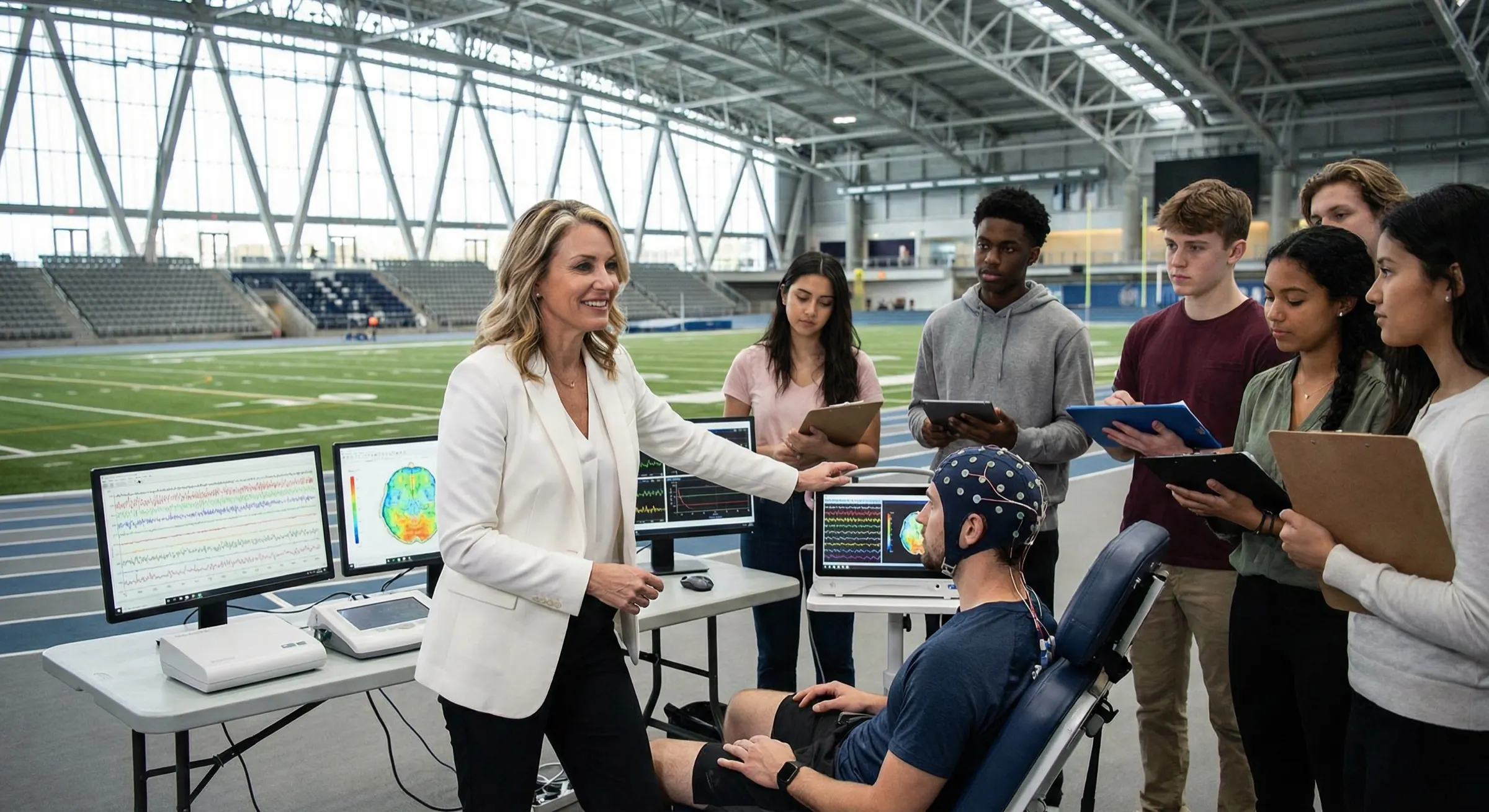
A certified EEG system measures the electrical currents of your brainwaves in real time via electrodes on the scalp. Your therapist analyzes this data and develops an individually tailored training program with audiovisual feedback – comparable to a film or video game that responds exactly to your brain activity. When the feedback runs smoothly, your brain perceives this as a reward (eustress) and learns, in a playful way, to retrieve the desired brainwave configuration on its own.
| Training Phase | Goal | Benefit |
|---|---|---|
| Focus training | Train peak concentration individually | Faster, more precise decisions |
| Deep relaxation training | Train recovery individually | Recovery, stress resilience |
| Dynamic training | Retrieve both states alternately | On-demand peak performance under pressure and fast recovery afterward |
Who Is Peak Performance Training For?
Our high-performance clients include managers, pilots, elite athletes, musicians, and students who want to specifically boost their physical and mental performance. After just a few training sessions, you apply the newly learned behavior at the right moment in your profession or sport – for measurably higher performance under pressure.
How Do You Recognize a Phase of Overexertion?
Anxiety, exhaustion, a declining attention span (less than 40 seconds), increasing errors, and emotionally driven decisions are typical warning signs. Our institute specifically supports your performance – even if it has already suffered.
Evidence from the field
Proven in Elite Sport
Neurofeedback is now a standard part of the training regimen of numerous world-class athletes. A 2024 systematic review found positive effects on reaction time, attention, and stress regulation in 16 of 17 studies examined, and a 2025 meta-analysis of 1,230 athletes confirmed significant improvements in mental health, athletic, and cognitive performance – including attentional control, balance, and coping with pressure situations. For example, amateur golfers improved their putting accuracy by 21 percent after just three sessions, and endurance athletes sustained effort 11 to 30 percent longer after training than before. Institutions using this approach include professional golf tours, Formula 1 teams, the United States Olympic Training Center, and the Norwegian and Canadian Olympic training centers.
Proven in the Military and Space Travel
NASA has used neurofeedback in astronaut preparation since the 1960s; recent studies such as Poland's IGNIS mission show that trained astronauts have stress levels after ISS missions almost identical to those before launch, while untrained control groups showed elevated inflammation markers and slower reaction times. In the military domain, neurofeedback is used at various stages of operations, including by US Special Forces, Navy SEALs, and through the US Army Center for Enhanced Performance, both to enhance performance and to treat stress symptoms.
Proven for Surgeons and Executives
The benefits are also clear in high-precision, high-pressure professions: in surgical residents, neurofeedback training reduced cognitive workload and supported recovery from burnout symptoms, and neurosurgeons increasingly use real-time brain data to improve decision-making and surgical precision. Among executives, specialized programs show significant improvements in stress tolerance, emotional stability, and cognitive flexibility, and heart rate variability biofeedback is now considered a key tool for clearer strategic decision-making under pressure, faster recovery, and better sleep quality.
Scientifically Grounded, Without Medication
The Institute for Neurofeedback and Biofeedback I-NFBF combines state-of-the-art neuromodulation technologies with training methods specifically developed for executives. Improvements in performance, resilience, or sleep quality often appear within the first one to three training sessions; sustainable results without medication are achievable from ten sessions onward. Remember: targeted repetition is the key – sometimes just a few minutes of training a day are enough to rebuild your brain.




Results vary with the goal, baseline and individual response; no specific performance outcome can be guaranteed.
Discuss your performance goal
In an initial conversation, we clarify your goal, the pressure situation and a suitable approach.