Spectral slowing
More delta and theta, less alpha and beta. One of the most consistent early markers of Alzheimer’s.[1]
Treatment centre
Most people wait for the diagnosis. We start earlier.
Prevention. Not reaction.
Cognitive decline announces itself years before it becomes visible. Anyone who waits until the first symptoms appear has already lost valuable time. Smart Aging at I-NFBF starts where prevention still works: long before diagnosis.
Your brain sends warning signals long before you feel them. qEEG research has identified brainwave patterns that precede cognitive decline and Alzheimer’s dementia by years, well before clinical diagnosis.
More delta and theta, less alpha and beta. One of the most consistent early markers of Alzheimer’s.[1]
It changes measurably. In the review cited below it separates Alzheimer’s patients with 76% sensitivity and 85% specificity.[1]
As the ratio rises, so does annual dementia risk, including in people without symptoms.[1]
EEG changes appear before atrophy is visible on MRI.[1]
The Korean research company iMediSync built an AI-assisted EEG index on this work. In a blinded evaluation of 416 people from three clinics it reached 93% sensitivity and 90% specificity for the early detection of amnestic mild cognitive impairment.[2]
The markers are known. The question is whether you use them.
What is shown, and what is still open.
In a randomised sham-controlled trial, memory improved more after upper-alpha neurofeedback than under random feedback, and the gain held for at least a month.[3]
Training studies report better memory and processing speed. The picture is not uniform: in sham-controlled comparisons the effect on attention is smaller.[4]
The available studies are small and rarely controlled. Slowing the course is therefore not established, and we do not promise it.
The greatest gain is therefore not in treatment. It is in prevention.
Not every brain ages at the same pace. Certain prior events change the risk considerably, regardless of age on paper.
Do you belong to one of these groups? Then every year you start earlier counts.
No standard protocol. Your brain, your findings, your training plan.
Your individual brainwave profile compared against age- and risk-specific reference values.
Heart attack, trauma, depression, lifestyle: all of it feeds into the plan.
Training addresses what your findings actually call for.
Cognitive fitness does not hold by itself. We secure the progress long term.
The statements on this page refer to the following work.
These are separate, individually billed services. Before a session, we discuss the purpose, procedure, relevant precautions and individual suitability.
Separate services
A concise description of each procedure.
A consultation-led programme that may combine selected measurements and self-regulation practice. The plan is agreed individually; no anti-ageing or disease-prevention outcome is promised.
Neurofeedback or biofeedback practice for focus and composure in specific demanding situations.
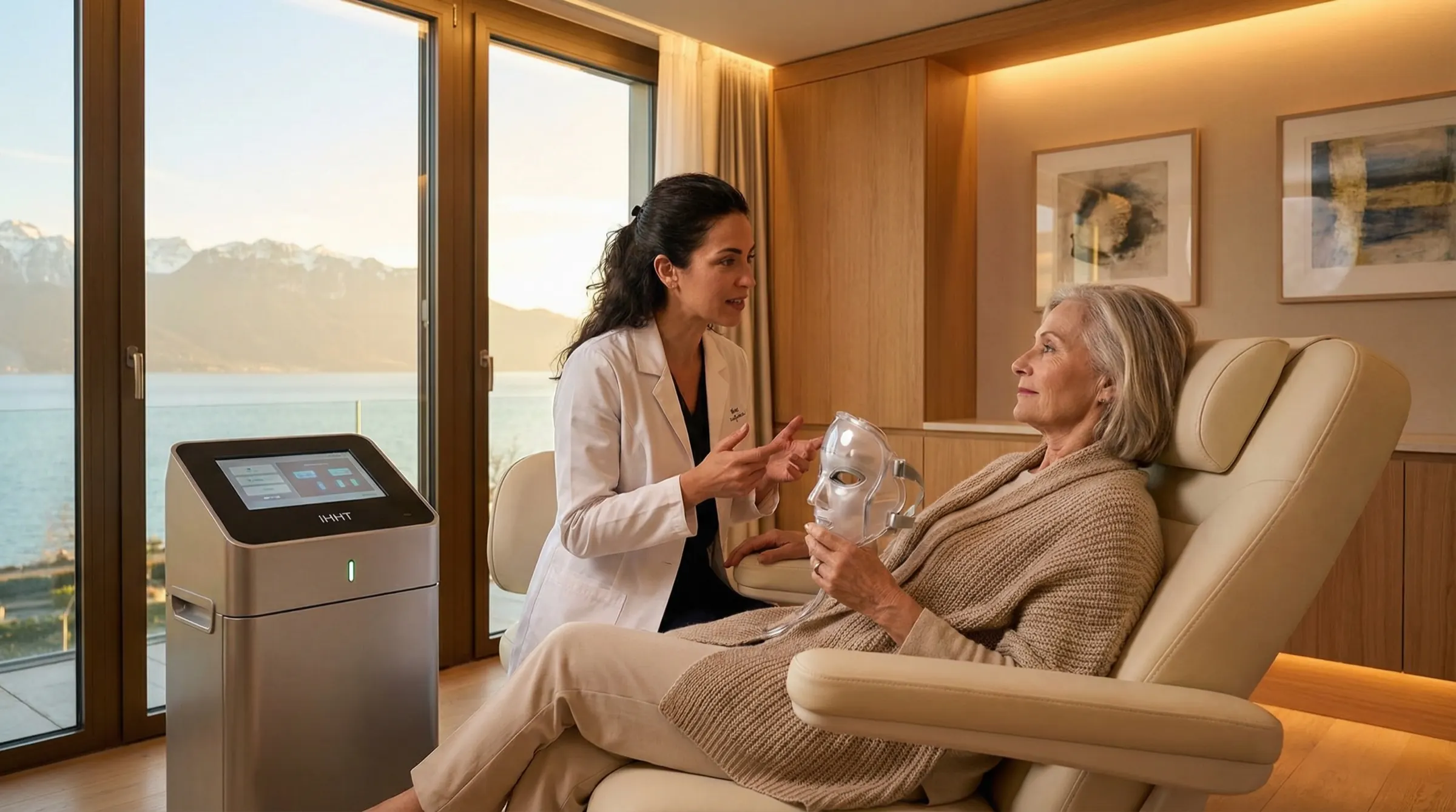
Intermittent hypoxia-hyperoxia training uses a mask to alternate lower- and higher-oxygen air while the person rests. Suitability and contraindications must be reviewed before use.
Low-level electrical current is applied through skin electrodes. We explain the device, intended use and relevant precautions before a session.
Red or near-infrared light is applied using a dedicated device. We discuss the intended use, eye protection and relevant precautions before a session.

Every service starts with a consultation. We explain the procedure, review relevant health information and precautions, and answer your questions before deciding whether to proceed.
Suitability depends on the service, health history and goals. We review this before recommending an appointment.
Sometimes. Any combination is planned individually after reviewing the purpose and relevant precautions.
These services are billed separately. We provide the current fee and terms before an appointment is arranged.
Cognitive reserve is not built overnight, but it can be built deliberately if you start now. In an initial consultation we show you where your brain stands today.